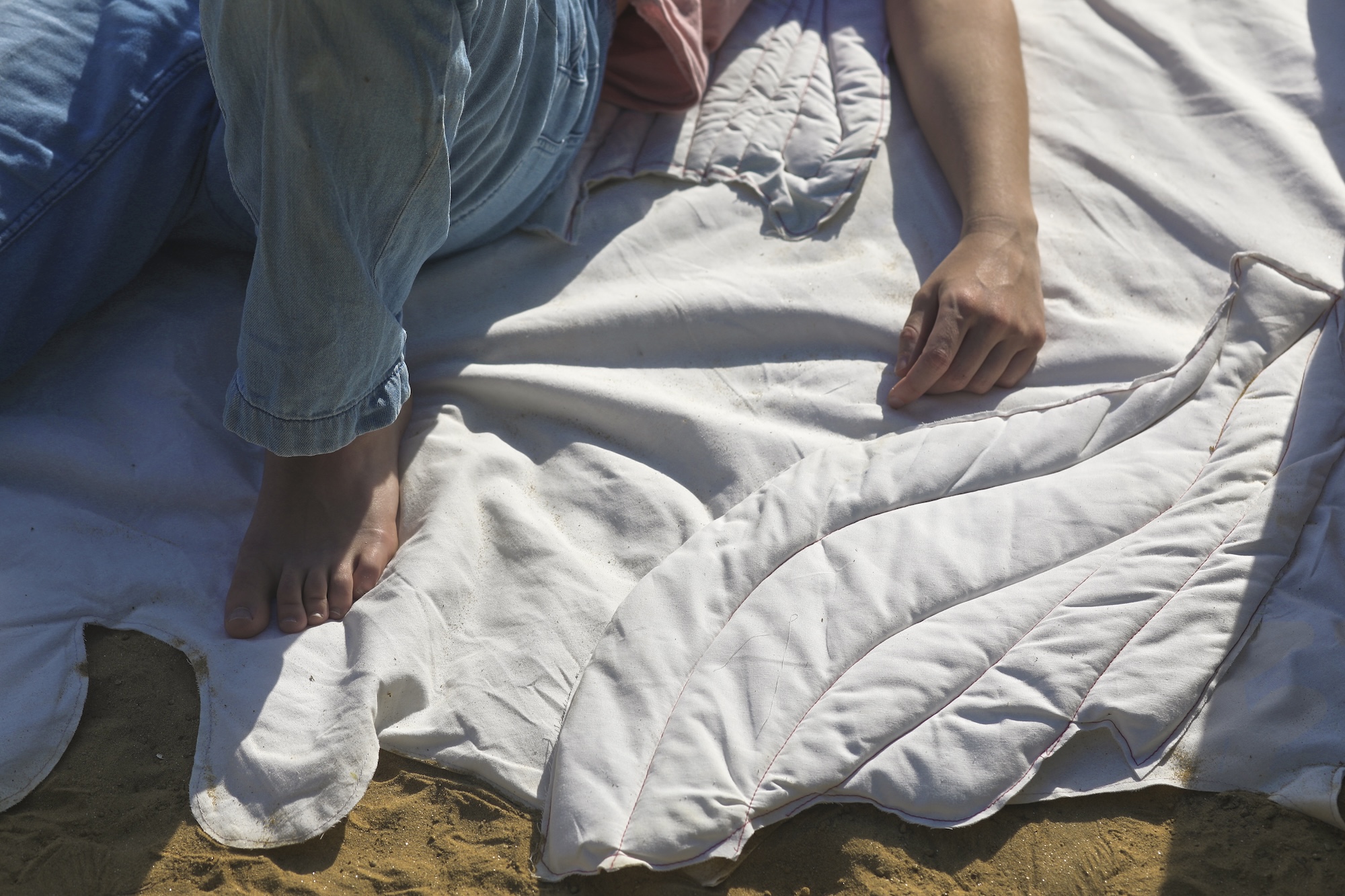
Wind, water, sand and a couple of rocks to keep about 60 wing-shaped cushions and two huge lung-shaped blankets from flying away. This is the materiality shaping the spatial environment of our workshops titled "Let the water transform" at Klimabiennale 2026: Unspeakable Worlds (Vienna, AT).
What might first bring the picture of a beach to mind, is actually a temporary landscape structure at one of the biggest squares in Vienna. At Karlsplatz, a beach the size of a massive living room stretches out in front of an artificial waterfront. This place served well for launching not only our participatory workshop, but also the 7th edition of our annual “arts of change” mentoring programme by the Austrian association “forum n”. In 2026, the programme’s focus lies on fostering matters of care and action through art practice. While we prepared its concept throughout the spring season, we also co-created a textile installation and participatory workshop titled “Whatever happens to the wings”. For the first set of performances, we explored the installation’s potential as both a platform and tool for collective healing together with diverse groups of participants.
As the core concept of our mentoring programme is collaboration, this project was brought to life by an interdisciplinary project team, art mediator Julia Herzog and visual artist Tereza Sýkorová. For this article, we chose a joint writing approach in which two perspectives and disciplines complement each other. With this text, we would like to emphasize its social relevance and bring you closer to the atmosphere of the entire workshop.
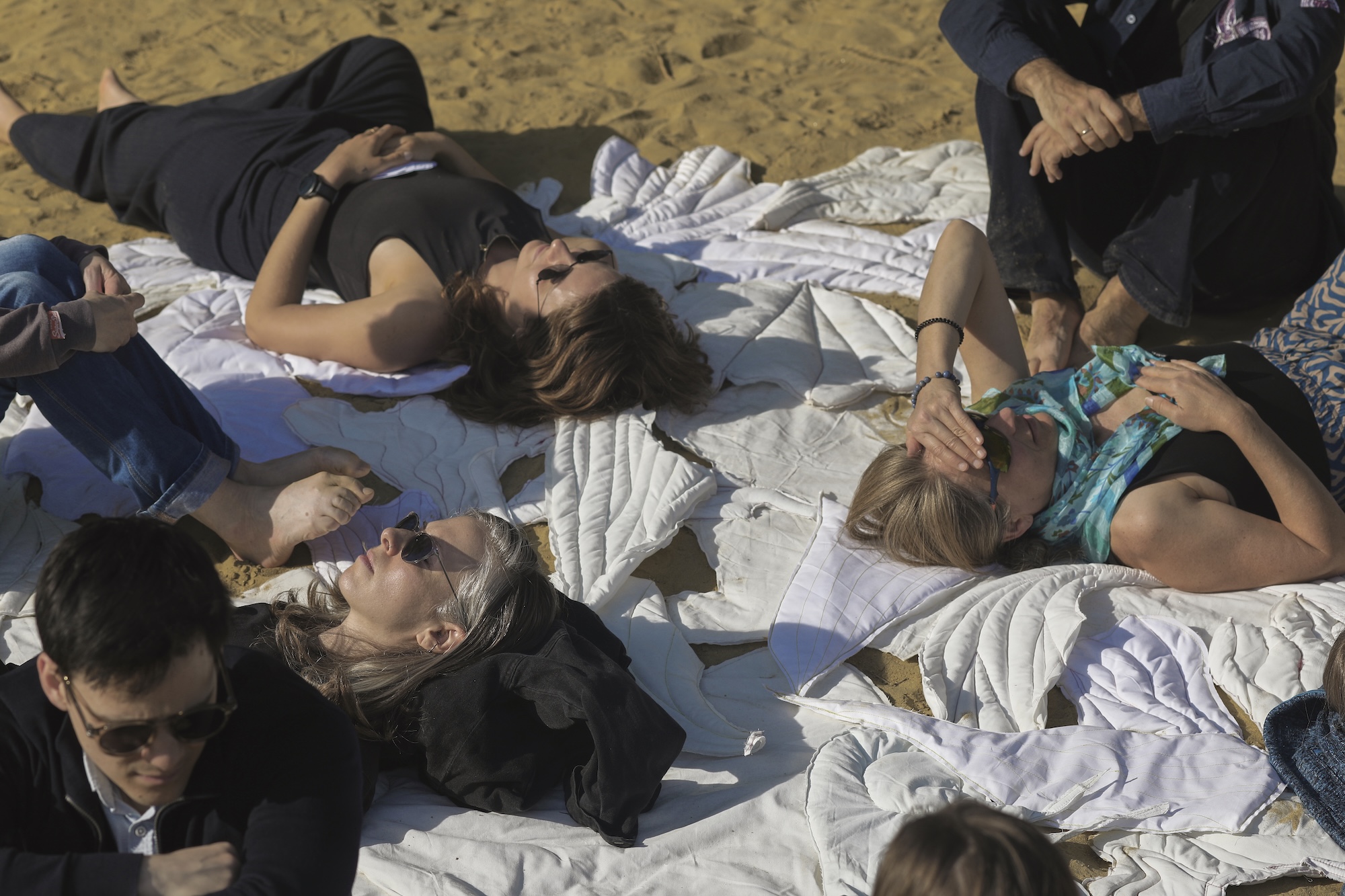
“Amid everyday hustle and rush, in the heart of the city, besides the tiny lakeside and under the eye of a cathedral, people gathered to collectively heal. Together, on butterfly-shaped pillows, they said goodbye—using fragments of paper wings, carried away by the water—to things that no longer served them.”
Haptics and symbols of a safe space
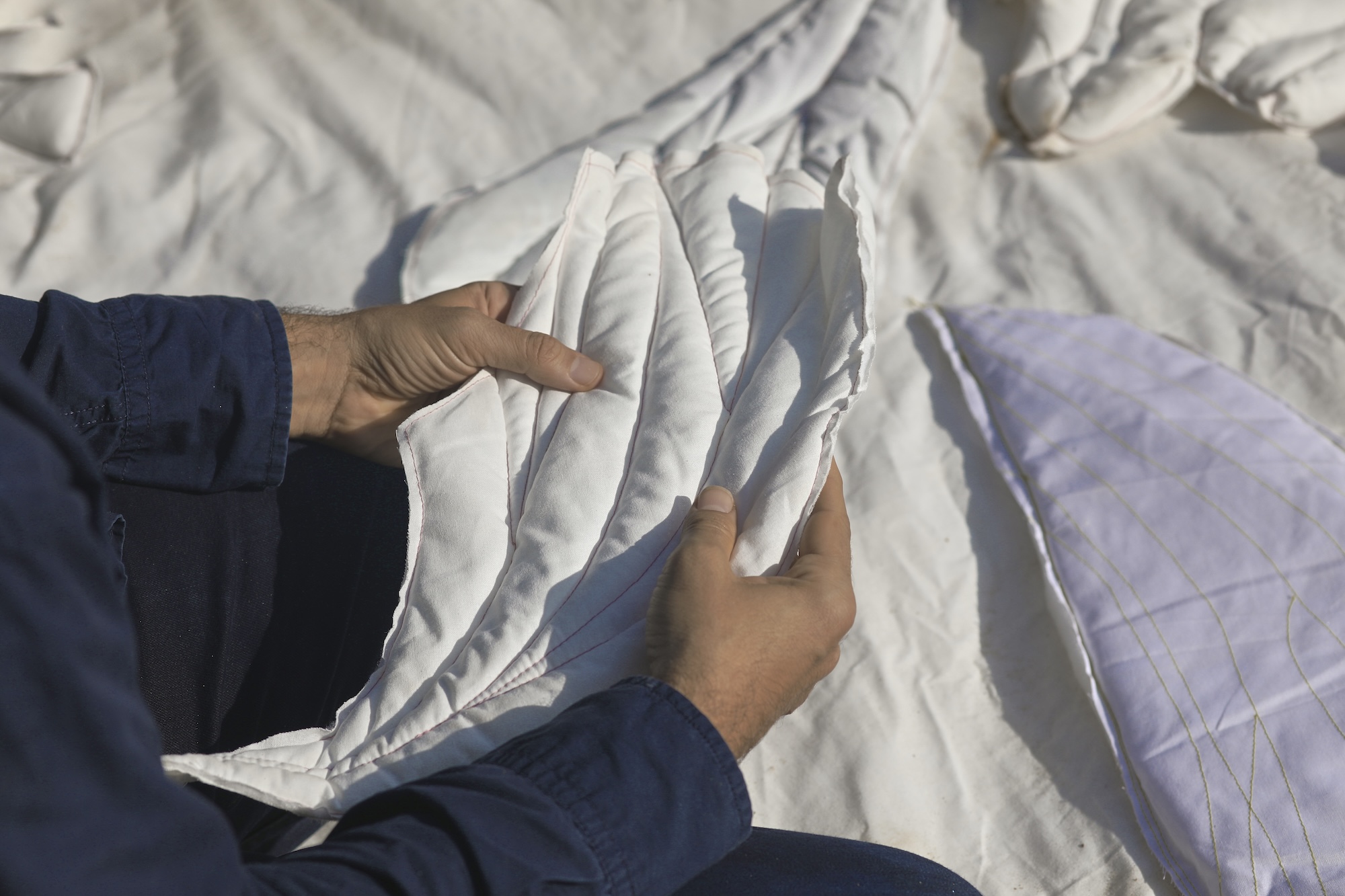
"Whatever happens to the wings" aims at unifying two contrasting dimensions of a healing process. It consists of 60 different wing-shaped cushions reminiscent of butterfly wings and two big blankets reflecting the shape of the human lungs. On the one hand, the material fragility of these textile pieces express the frequently trauma-related sensation of dissolving as a response to high pressure in close surroundings. This is a natural reaction of any healthy system to eventually relieve pain. As the human lungs are often said to carry intense emotional and physical distress, the blankets' shapes are intentionally chosen to signify the most central and important organs of the human body. Creating a spacious, yet light seating area was one of the ideas behind the concept for this installation.
In some way, lungs carry both heavy and rich characteristics as well as unobscured and clear qualities within their entity. The butterfly-shaped wings, on the other hand, signify sole lightness in its purest form. Based on a previous artwork created through the transformative power of water—in which water brought a butterfly to the camera’s lens—this moment has manifested as a physical, safe space for transformation."
The haptic qualities of the textile pillows and the sensation of touching them were essential for us to let participants become part of the space. Both elements are reflected in the aesthetics of the installation, representing forgiveness, acceptance.

The artwork “Whatever happens to the wings” originates from the desire to create a tool that softly intertwines inner motion with transformative movement in physical space through acts of self-reflection and embodiment. Textiles have specific properties that align well with the theory of care: they are soft and tactile, bear the marks of time and use, connect body and memory, and are associated with protection and repair as a metaphor for social healing. They teach us to live with wounds and transform them. The act of letting go is considered here as an act of care and trust. And as the butterfly theory says: even small changes can lead to unpredictable consequences over time. Therefore, we believe in its positive transformative power.
Spatial interrelation and public interaction
Throughout the workshops, participants were repeatedly invited to interact with the installation and change the spatial order of wings to rework existing patterns. Eventually, this re-alignment in outer space also naturally initiates inner motion. As an introduction, we collectively listened to a sound piece titled “Let go on everything” written by Tereza Sýkorová and sung by Francesca Brigandi, which gradually led us to self-reflection and thus became a link between our inner experience and the actual presence of water in our immediate surroundings at Karlsplatz. This served as an acquaintance with water, being the ultimate substance of connecting all living beings, and transformative action.
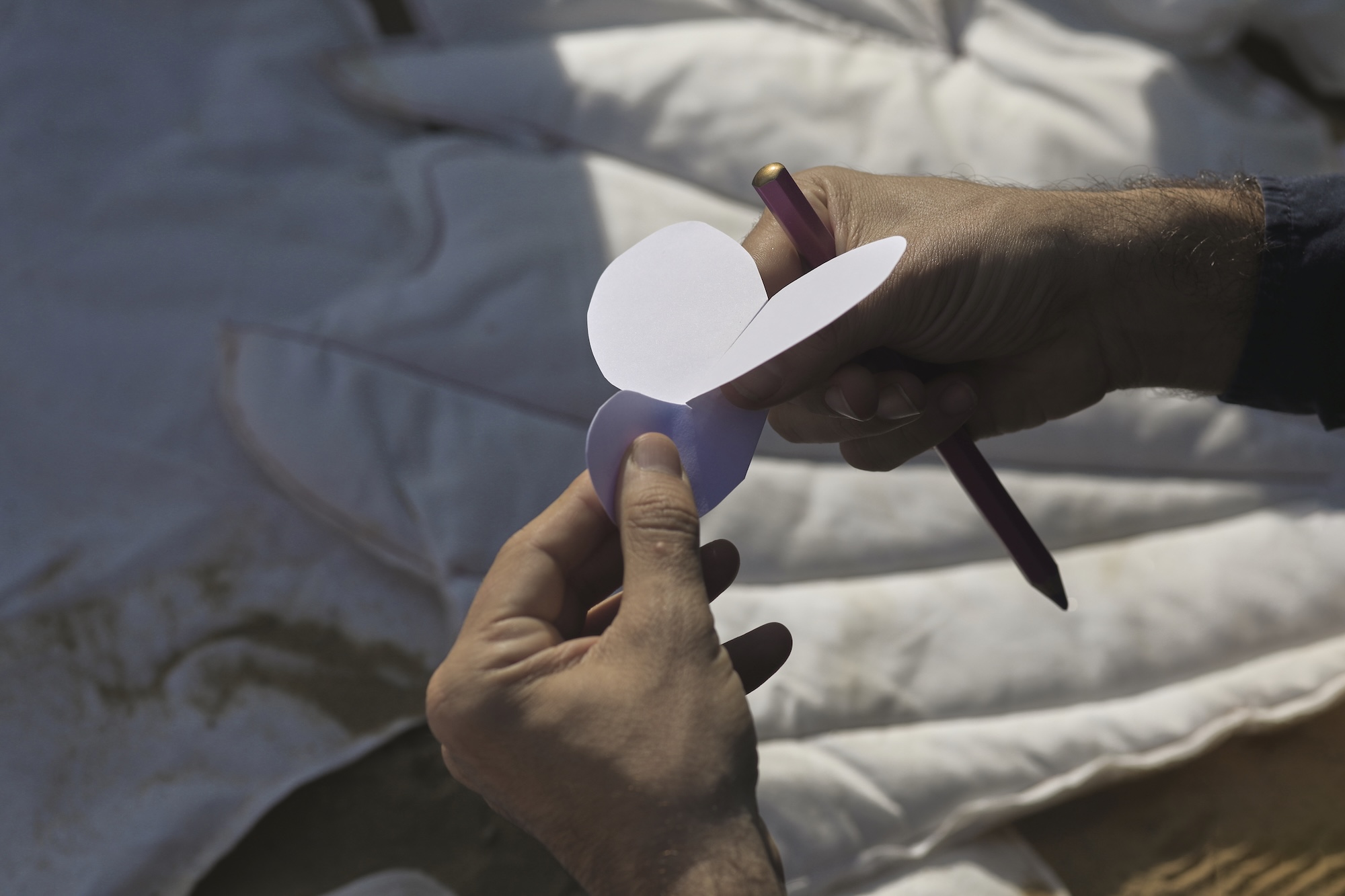
Amidst the turbulence and chaos of public space, several people were then lying, sitting or kneeling on textile blankets for about five minutes to let the audio shift their focus onto listening for the voice within. We then guided them through a writing session in which they received space to individually write down what they wanted to let go of on paper representing the shape of butterflies.
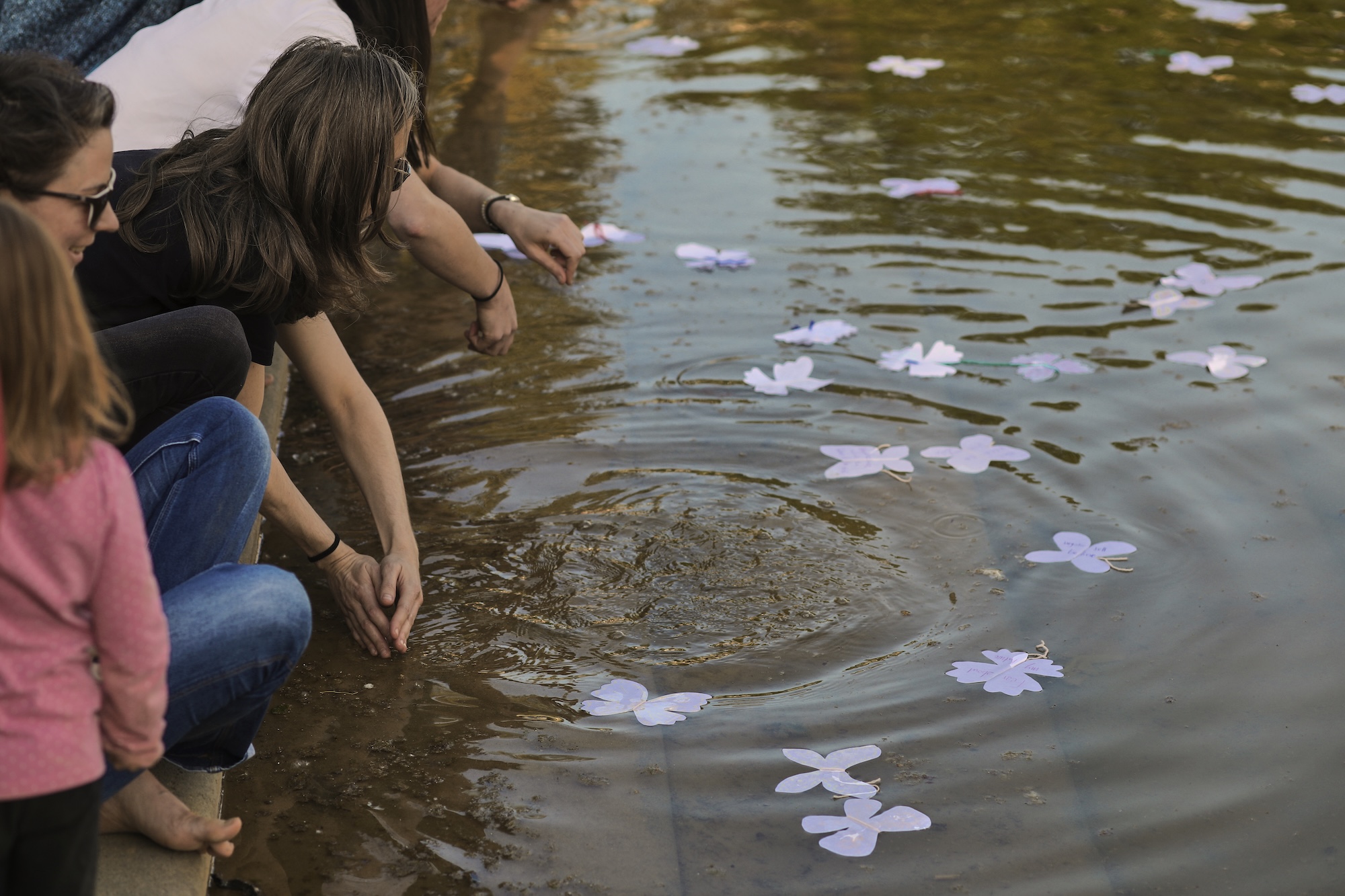
Throughout a closing ritual, all these butterflies were jointly put on the water surface at Karlsplatz. Together, we watched them float away. Some of the writings disappeared, others refrained from vanishing. Some of the butterflies sank, others rested on the calm surface of the waterfront.
“At the start of the workshop, people arrive with a slight sense of distance. Some of them seem a little shy. We welcome them and hand them one of the wings, inviting them to take a seat in our shared space and, by placing a textile butterfly wing, to help co-create the space we will share throughout the session. Me and Julia are thinking: “no movement is wrong; each contribution to this space is welcome”. This is what we want to bring across throughout the entire workshop sessions. People slowly settle and fill the empty spaces on the blankets, through which the sand covering much of the public space next to the water is visible. Inside, I’m cheering and looking forward to the next interaction. As an opening activity for the workshop, Julia invites the participants to reflect on the theme of water, asking which wing from the installation they feel most related to, what it brings to mind for them, and if they want to share their last encounter with the substance of water. Everyone is seen.”
The theme, the workshop, and the cushions placed in the middle of the public space helped us create a space for spontaneous interactions. The groups of people who joined us to explore the installation's transformative potential were quite diverse. And although our installation was placed amidst a heavily vibrating area shaped by all people passing by, participants were deeply engaged with the practice of listening, writing and in a special kind of intimacy that, in turn, fostered a feeling of community and connection. Even without explicitly stating what each person wants to let go of, sharing this process has brought us closer together.
The participants in our workshop appeared calm and satisfied after immersing themselves in their inner worlds together, briefly touching upon the sorrows and regrets that unite us all, even without expressing them aloud. Throughout the workshop, we made sure that everyone felt safe and secure in the environment while engaging in self-reflection activities. Whenever space is created for reflection and sharing, a supportive social and spatial structure must be consistently present to facilitate healing processes. Our experience with art mediation shows that when developing healing mechanisms through creative activity, it is essential to maintain a balance between observing and holding a space.

Listening, sharing, mutual support without stigmatization, connection, and collective consciousness, as well as the nonverbal expression of emotions in a safe environment, enable inner transformation. These are the fundamental philosophical pillars of the “arts of change” programme, which, in addition to transdisciplinarity and solidarity, also aims at fostering social sustainability, inclusion, and just collaboration.
“arts of change” is a participatory mentoring programme run by the association “forum n”. It offers art and music students the opportunity to engage deeply with the themes of art, sustainability and socio-ecological transformation. After seven project years, the “arts of change” programme now draws on a constantly expanding network of art students, within which they can share ideas and collectively reflect on the sustainability of creative action and the impact of their diverse artistic practices. Eventually, their initiatives aim to promote sustainability both within and beyond higher education institutions.
https://forum-n.at/projects-arts-of-change/